// before 2007
Under the 1998 Land Law, anything not expressly protected as natural or agricultural could be made buildable.
01 why we don't build
Land-to-roof bottlenecks.
Over the past decade and a half Spain has stopped building. Why?
In Spain, every plot's use is set municipally by a master document — the General Plan (PGOU): a document where the city council classifies each parcel as buildable or not. Then, in 2007, the default switched.
// before 2007
Under the 1998 Land Law, anything not expressly protected as natural or agricultural could be made buildable.
// after 2007
Land has to be expressly justified as needed in order to be reclassified as buildable.
The intuition was reasonable — cool down the speculative sprawl that had fuelled the early-2000s bubble — but the moment you pair a stricter front door with a thicker stack of paperwork to walk through it, you've turned a sensible filter into a chokepoint. Even bringing a single plot to market becomes a multi-year exercise.
// then the layers piled on top
Between roughly 2010 and 2019, layer after layer piled on top. The clearest example is the 2013 Environmental Assessment Act, which extended the cases subject to "strategic environmental assessment". Almost any non-trivial change to a General Plan now requires four parallel procedures:
// a
Parallel environmental procedure, with its own public consultation.
// b
Detailed environmental study of the area.
// c
Final environmental statement, issued by a different administration.
// d
Follow-up monitoring after approval.
Each step has its own timetable; any of them can stop the clock. On top of that, regional governments piled their own — landscape integration studies in Valencia, health-impact assessments in Andalusia, economic-sustainability reports almost everywhere. Andalusia's own planning chief estimates around 100 sectoral reports are needed for a single new General Plan.
And these layers don't just hit phase one — reclassifying the land. They also hit phase two: the Partial Plan, the project-level document that, once a piece of land is buildable, defines exactly where streets, plots, densities and amenities will go on it.
// and two legal amplifiers
Two legal mechanisms multiply the friction:
// negative administrative silence
In Spanish urbanism, if the administration does not respond within the legal deadline, the request is treated as denied. Bureaucratic inaction equals "no".
// proliferation of veto points
Any neighbour, association or higher administration involved in any of those reports can sue, and a successful challenge typically voids the entire procedure rather than just the contested item. NIMBY actors don't need to win on the merits, only to delay.
Let's look at it at ground level.
// general plan · the first step
Madrid is still governed by its 1997 General Plan. Renewing it has been attempted for decades.
Meanwhile, every new development has to squeeze through point modifications and partial plans that take years at every step.
// annulled sectors
On 28 September 2012, Spain's Supreme Court annulled 22 sectors of the Plan. In one ruling, up to 135,000 planned homes were left in limbo because of formal defects in the procedure.
In 2016 the Supreme Court rescued 21 of the 22 after the City Council's revision. But four years passed between ruling and rescue in which those plots could not be touched.
BBVA Research estimates that two thirds of the planning frameworks in force in Spain predate 2008. Urban gridlock.
// operación campamento
Even when the General Plan does not need to mobilise new land, the next phase gets stuck: this next phase is usually a Partial Plan, the project-level document that defines what the actual new development will look like.
Take Operación Campamento in Madrid. 211 hectares in southwest Madrid. 10,700 homes, 65% subsidised. The first agreement between the Defence Ministry, the Madrid Regional Government and the City Council was signed on 6 June 1989. In other words: it was already inside the 1997 General Plan. But the Defence Ministry's land had to be acquired and a Partial Plan drawn up.
Defence cashed the first instalment in 2011. The Partial Plan fell with the 2012 ruling. SEPES (the central-government public land developer) formally bought the land in October 2023. The development project was initially approved on 27 February 2025. The first homes won't be ready before 2027–2028: nearly four decades since the agreement.
// cuatro caminos depots
A smaller, more recent example. Antonio Palacios and Miguel Otamendi designed Madrid Metro's depots in Cuatro Caminos in 1917. The first Line 1 train left from there on 17 October 1919.
The blockages also kick in even when the project is small enough not to need a Partial Plan. In 2014, under Mayor Botella, a plan was approved to replace the depots with 443 homes. The successful cooperative demolished the building between March and June 2021, despite pending appeals. The High Court of Madrid annulled the plan on 9 May 2025. The Supreme Court confirmed it on 11 February 2026. The plot is still empty.
// the metropolitan ring
Out of the capital. Madrid alone shouldn't bear the housing pressure: it should be shared with the municipalities of its metropolitan ring. They don't.
Eleven mayors of the ring —among them Alcorcón, Fuenlabrada and Getafe— have filed a municipal legislative initiative to force the declaration of stressed market areas. Meanwhile, several developments have sat on the books for two decades without moving.
Nobody wants to take in new housing: let the neighbour do it. The catch: Spain has more than 8,000 municipalities. There are a lot of "neighbours".
// rivas-vaciamadrid
Rivas-Vaciamadrid presented the draft of its new General Plan on 5 June 2025. Declared model: consolidate the existing urban fabric. Official tagline: "Rivas will be the southeastern Casa de Campo".
On the maps: −46 % of buildable area in Cristo de Rivas and the elimination of nearly 3,000 homes planned in Mirador Sur. Years ago Rivas had already paralysed building permits because of insufficient basic services. The pressure for more affordable housing for young people clashes with the limit the municipality is imposing on itself.
// majadahonda
Majadahonda, northwestern metropolitan area, conservative municipal government. The Arroyo del Arcipreste sector —363,000 m², 620 planned homes, 286 subsidised— has been requesting development since 2004.
Twenty years stalled. No court ruling blocking it, no pending sewer, no judicial appeal. Initial approval finally arrived on 29 May 2025. Two more sectors —Huerto del Parrito and Valles de la Mina, 1,257 additional homes— were approved shortly after. Twenty years was not technical hurdles, just political will.
// closing
Madrid is just an example of what happens across Spain.
Cases in other cities
Voices from the trade
Even with the land and the plan in order, putting up a residential building.
// the typical project
The building that could be put up in an area of free expansion and available land: east of the capital, just below Barajas airport. Air-easement limits do exist there, but they are 45 metres, enough for 13 storeys. Yet we are building below. Why?
From here, on this very building, the restrictions kick in.
// height
West of Barajas airport the air easement set by AESA (Spanish Aviation Safety Agency) allows up to 45 metres without prior authorisation.
Yet recent developments in the area —Sanchinarro, Las Tablas, Valdebebas— have stopped at around six storeys, some 19 metres. Why? Because the zonal rules of the General Plan and the partial plans of each PAU (the large planned-expansion districts of the 1997 plan, akin to a Partial Plan) set it that way. Where there was airspace and land headroom, building below was agreed.
// envelope and Building Code
The current Building Technical Code —last big revision in Royal Decree 732/2019, in force since September 2020— requires thicker building envelopes, aerothermal heating or equivalents for hot water, mandatory rooftop photovoltaics and near-zero energy demand. All at once.
A new Royal Decree is in the works to transpose the European Energy Performance of Buildings directive. The Madrid College of Surveyors estimates an additional 18,000 euros per home. The Ministry of Housing denies it.
// electricity grid
Down to the street. For the building to work, it has to be connected to the low-voltage grid. Whether a project moves forward depends on the distributor confirming firm capacity at its node.
In 2024, according to BBVA Research, 88% of distribution-grid nodes were saturated. The urban-development sector requested 6.7 GW of grid access and most could not be served. The Madrid Regional Government denounces that 116,000 homes planned for the southeastern developments have been left out of the 2025-2030 state electricity plan.
This is how long the road from buildable land to handing over the keys in a new neighbourhood can take.
// everything becomes time
Each of the previous bottlenecks —the land, the plan, the project restrictions— translates into something very concrete: time. Let's add it up, phase by phase, with the source on the side.
// general plan
Approving a new General Urban Plan in Spain takes between 10 and 12 years. The Madrid Regional Government itself acknowledges this when presenting its 2026-2027 Housing Shock Plan (Idealista, Sep 2025).
The Urgent Measures Act passed in April 2026 promised to bring that period down to six years. To be seen (Madrid Regional Government, 22 Apr 2026).
// partial plan and urbanisation
Once land has been classified as buildable, approving the partial plan together with the land readjustment and urbanisation works takes between 3 and 7 additional years (APCE; book, p. 89).
Operación Campamento was signed in 1989 and still has no homes delivered; Los Berrocales has 20 years on its original Partial Plan; El Cañaveral delivered its first homes in 2016, thirteen years after the procedure began. Madrid Nuevo Norte, considered a "record pace", took six and a half years between initial approval and dismissal of the last appeals (Idealista, May 2025).
// permit
The legal deadline to issue a major building permit is three months. No major city council meets it (ASPRIMA). The EY/ASPRIMA study estimates the average delay at twelve months and the additional cost to the buyer at ~€13,000 per home (EY, May 2020).
The range goes from about six months in small municipalities to twenty-four months in central Madrid (Idealista, May 2025).
// construction and handover
Building a typical residential block, from permit to handing over the keys: between 18 and 30 months. Neinor's Esplugues development, announced in 2025, estimates 29 months until April 2028 (Observatorio Inmobiliario, 2025).
Assuming everything has gone well so far.
// closing of the time module
From the moment a city council decides to plan a piece of land until a family moves into a new neighbourhood that wasn't on the books: up to 20 years.
// time + regulation
Each year added to the process is financial cost, the risk that the project never happens and the chance that the rules change. Combined, time and regulation are the largest part of the cost of building new housing in Spain: they weigh as much as all other factors put together.
// credit
Credit stock for construction and development fell from €452 billion in 2008 to €100 billion in 2019. Savings banks, where much of real-estate financing took place, disappeared. International banking regulation made real-estate risk on bank balance sheets more expensive.
Backing new construction is no longer attractive for banks (Banco de España; book, pp. 80–83).
// labour
Construction sector employers estimate that 700,000 workers are missing to cover the sector's needs in Spain, public and private (Cinco Días, 4 Nov 2024).
The average age has gone from 37 in 2007 to 45 in 2022; among bricklayers, 48. Only 10 % are under 30 —it was 25 % in 2008— and 75 % of executives flag the shortage of skilled labour as the main obstacle to their projects (BBVA Research; book, p. 95).
// materials
Between 2018 and March 2024, INE recorded increases of 50 % in cement and ceramics, 50–60 % in bituminous materials, almost 50 % in energy and over 30 % in copper (INE, materials price indices; book, pp. 96–97).
Spain has hardly any industrialised housing to cushion these jumps: its weight is marginal compared with Sweden or Japan.
// productivity
Since 2013 labour productivity in construction —gross value added per hour worked— has fallen by more than 20 %; in the economy as a whole it has grown 5 % (BBVA Research; book, p. 96).
The sector is fragmented in micro-businesses. Big Spanish construction firms now operate 80 % of their activity outside Spain (book, p. 96).
// the gap
Add it all up and costs exceed the price at which homes can be sold. Building new housing in Spain doesn't pay off.
And for the same reasons —cost, labour, credit, regulation, friction— building public housing doesn't pay off either, since it sells below market. No matter who builds it.
02 the consequences
To see the effects of that bottleneck, a standard measure: how many homes are completed for each new household. If the ratio stays around 1, supply meets demand. If it's lower, we fall behind.
spain · aggregated by intercensal period · a ratio of 1 would be balance
source: ine (population censuses and continuous household survey) and ministry of housing · esadeecpol's analysis.
Across the four decades covered by INE censuses, the ratio rarely fell below 1. The 2000s boom got us used to ratios above 1.5. But since 2021 we are at 0.38: for every new household, we deliver fewer than four homes out of ten.
When supply does not match demand, prices react. Between 2015 and 2023 the average price per square metre for sale in Spain rose 47 %. Wages grew only 17 %. For people aged 25 to 34 —the age at which most households are formed— wages grew only slightly more: 23 %. The gap is bigger in Madrid, Catalonia or the Balearic Islands, where housing is a more sought-after asset.
New households are not making it to ownership. Among under-35s, the share of homeowners has fallen from 67 % in 2002 to 32 % today. Those aged 65–74, meanwhile, are still where they were: around 84 %.
age of the reference person · banco de españa household financial survey
source: barceló & crespo, "housing tenure and mortgage debt of spanish families over the last twenty years", esadeecpol, 2025 · based on the eff (banco de españa). values approximate from the published chart.
Those who don't buy, rent. According to Banco de España, in 2007 32.2 % of young households (with a reference person under 30) lived in rental housing. In 2023 it was 56.6 %: more than 20 points in sixteen years. And it's not exclusive to the young: according to INE's ECV, in 2008 about 1.6 million households in Spain rented; in 2023 it's nearly three.
But renting is no shelter either. The gap between wages and rental cost is equal to or greater than for buying. The Valencian Community joins the islands at the top of the rental price increase ranking 2015-2022, with rises of around 85 %. Even the lowest are above 30 %. As a reference, we have already seen that wages rose 17 % (23 % for the youngest).
If you can't buy and rent suffocates, you don't leave home. The emancipation rate of those aged 25 to 34 —the group where most new households form— reflects exactly this: falling, almost without pause, for fifteen years.
% of people aged 25–34 not living with their parents · spain · ecv (ine)
source: own elaboration from ine's living conditions survey. the share of 25-34 year olds living with parents went from 40.6 % in 2011 to 54.4 % in 2025.
In 2011, almost six out of ten people aged 25 to 34 lived outside their parents' home. In 2025, fewer than five. Thirteen points in fourteen years. This is not just delays in life projects —forming a family, for example, in a country with one of the lowest birth rates in Europe. It is a limit on professional opportunities: in 2022, only 2.4 % of Spanish workers changed municipality for work reasons. The cities that concentrate the best opportunities are precisely those where it is hardest to settle.
03 build
Negative administrative silence in urban planning has to stop on consolidated urban land. A minor formal defect should not annul a whole project. Rationalise the right to challenge.
// evidence & cases
book, p. 145–146
Independent audit that finds duplicate sectoral reports, removes them and forces compliance with legal deadlines, with sanctions.
// evidence & cases
book, p. 147
When a city council blocks developments of general interest, the autonomous community should have veto power and subsidiary initiative. Enforce caducity dates of obsolete plans.
// evidence & cases
book, p. 148–149 (Mast, 2020)
Urban-planning instruments driven from the regional level that accelerate residential developments in strategic areas, with shared management and significant subsidised reserves.
// evidence & cases
book, p. 150
Allow more storeys where there is demand and services — automatically, without special conditions — and combine that density with strong public transport and mixed uses. Densify the consolidated city instead of pushing its footprint outwards into scattered PAUs.
// evidence & cases
book, pp. 141 and 154 (Lutz & Büchler, J. Urban Economics)
Spain has roughly 300,000 socially rented homes in public hands — about 3 % of the stock, against the 7 % OECD and 9 % EU averages. Reaching the EU benchmark would mean ~1.5 million extra homes — too ambitious for a single decade. A realistic ten-year goal: keep 1 in 10 of the 3M target in publicly held rental. That alone doubles the current stock and lifts annual deliveries from fewer than 10,000 to more than 30,000.
book, pp. 163-168
Real productivity through industrialisation: standardise components, manufacture in plant and assemble on site. Attract young talent with sector-specific dual vocational training.
// evidence & cases
book, pp. 160–161
04 regulate?
The instinct is direct: if the price rises and wages don't, cap the price. But the international evidence is fairly clear. A recent review by Konstantin Kholodilin across all generations of rent control concludes that they do limit prices — but at the cost of three adverse effects:
// a
Two thirds of studies find negative effects on the construction of new housing.
// b
Quality deterioration of the available stock is "almost unanimous" across studies.
// c
Frequent rises in unregulated zones; price drops don't reach the homes families most need.
In Spain, the most recent experience is Catalonia's Law 11/2020, later struck down by the Constitutional Court. The most robust empirical study, by Joan Monràs and José García Montalvo, used INCASOL's full deposit microdata for new rental contracts during the law's whole active period (Sep 2020 – Apr 2022).
In aggregate, rents fell about 5 % — but only on paper. Once you split by price tier, the law turned regressive: in regulated municipalities rents rose +12.7 % for the cheapest sextile of homes (vs +6.9 % in non-regulated controls) and fell −2.9 % for the most expensive (vs +0.6 % in control). The reference index acted as a floor for cheap rentals as much as a ceiling for expensive ones. The share of units priced above the index dropped from ~50 % before the law to 13–22 points lower afterwards. And the number of contracts signed fell about 10 %, again concentrated in the high segment — supply pulling out of the regulated tranche.
But there are regulations that do help, especially in consolidated urban centres where new supply isn't going to relieve pressure. Four levers that pass the filter.
Start by separating professional short-term rentals (continuous, year-round use) from occasional second residences let only off-season — they have very different effects on the long-term market. From there, regulate not as a global ban but with data: full registries, taxes that price in the externality, and zone-variable limits. Cross-checks with platforms make the distinction enforceable. Passes the golden rule because it returns professional STR supply to the long-term market without sterilising the occasional uses that don't compete with it.
// evidence & cases
book, pp. 199-204
Mutualise the non-payment risk instead of pushing landlords into casting tenants, demanding high deposits or retreating into seasonal contracts "just in case". The owner asks for fewer guarantees; more households can access private rental. Passes the rule because it adds effective supply.
// evidence & cases
book, pp. 204-207
The average eviction in Spain takes 2 years: it protects neither the tenant — who spends that time in uncertainty — nor the landlord — whose property sits frozen. Bring it down to 3-6 months, combined with a social housing stock that offers a real exit for the tenant. Passes the rule because it unblocks units that are paralysed today.
// evidence & cases
book, pp. 205-209
Long-term public-private agreements with large owners, with prices and durations set up front. The state secures stable supply at a known price; the landlord secures predictable cash flow with no rotation cost. Passes the rule because it mobilises existing units into the long-term market without new construction or price ceilings.
// evidence & cases
book, pp. 184, 207-208
// the book
From scarcity to abundance.
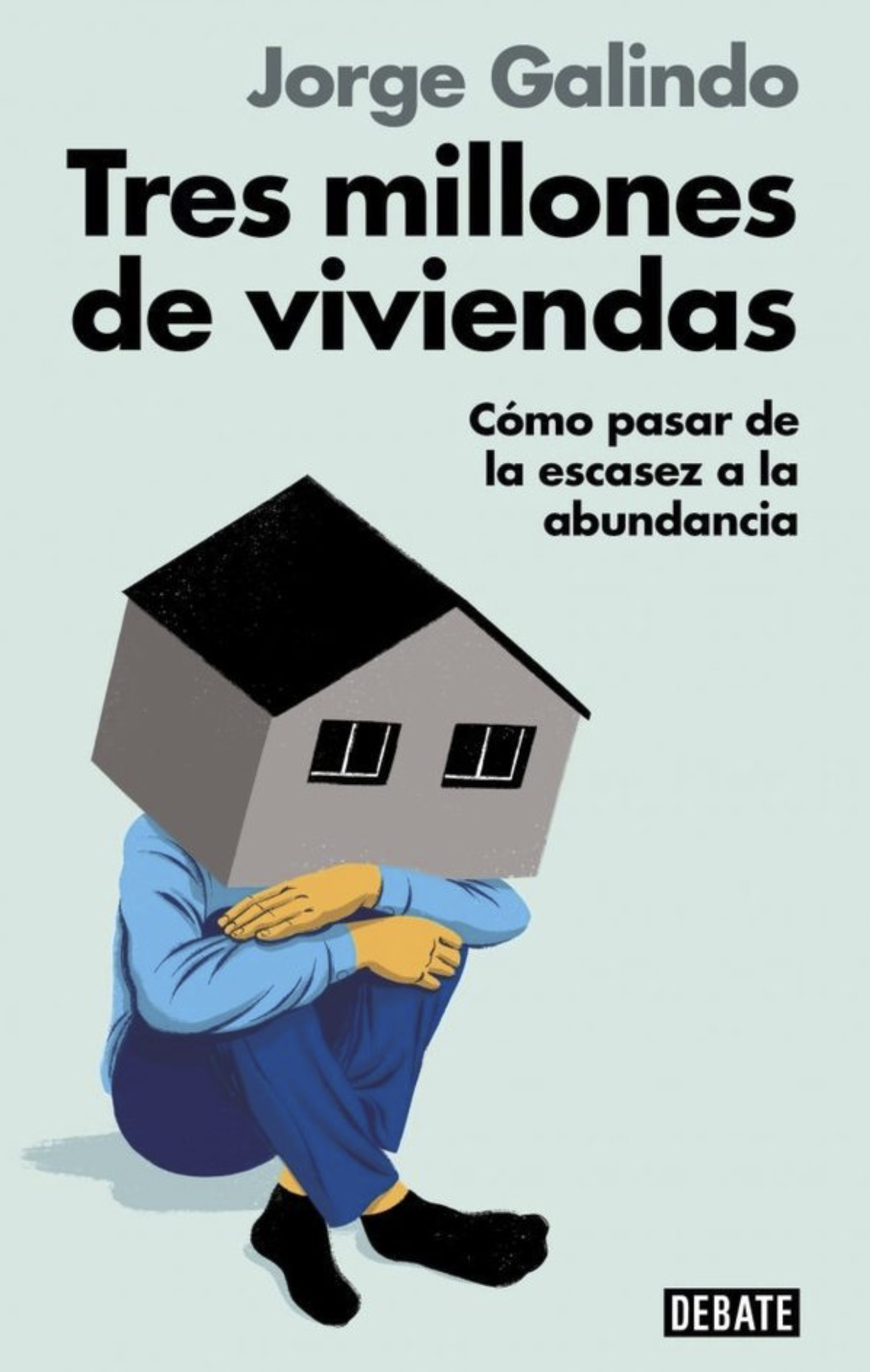
If any of this caught your attention, the book tells the whole story, with all the sources and nuances that don't fit here. Debate, 2025. (Spanish edition only for now.)
// where to find it
// references
All the content of this site is based on the research carried out for the book Tres millones de viviendas (Jorge Galindo, Debate, 2025; Spanish only). This is the filtered source list — the notes from the book's bibliographic apparatus that support specific claims on this site, plus sources later than the book or external to it. One entry per source, ungrouped. Citations are kept in Spanish where the source is in Spanish.